Skip to Content

Brought to you by Classic FM Magazine

Leonard Bernstein

1918-1990

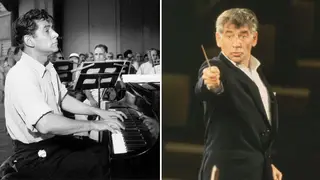
His impact on a whole range of disciplines, from conducting to interpretation, from composing to education at all levels, was colossal. Leonard Bernstein was one of the great musical geniuses of the 20th century.

Life and Music

  • Bernstein's early musical education reads like a who's who of American music in the 1930s and 1940s.
  • At Harvard, his tutors included Walter Piston, and at Philadelphia's Curtis Institute the great Fritz Reiner for conducting and composition with Randall Thompson.
  • From 1940 to 1941 Bernstein attended the Tanglewood music school, initially on a scholarship, but made such an impression that Serge Koussevitzky promptly invited him to become his assistant for the 1942 summer session.
  • His meteoric rise to stardom continued the following year when he was appointed deputy to Artur Rodzinski at the New York Philharmonic, and subsequently made his sensational debut in 1943, standing in for an indisposed Bruno Walter.
  • In 1943 Bernstein made his debut as a performer-composer on disc with his Clarinet Sonata.
  • As a composer he won critical acclaim for his ballet Fancy Free (1944), the filmed musical On the Town (1944), and his first two symphonies Jeremiah and The Age of Anxiety.
  • World premieres of works by Blitzstein and Shapero, Messiaen's TurangalĂ®la Symphony, and the first American performance of Britten's Peter Grimes reflected his energetic support for contemporary music; in 1943 he introduced and conducted 'workshop' readings of American compositions in Carnegie Hall.
  • In 1946 he gave his first performance of Ravel’s G major Concerto, directing the orchestra from the piano.
  • In 1953, Bernstein became the first American to conduct the orchestra of La Scala opera house in Milan - with Maria Callas in the lead role.
  • In 1954 he was nominated for an Oscar for On the Waterfront, and then scored two consecutive hits with Candide (1956) and West Side Story (1957).
  • From 1958 to 1969, as principal conductor of the New York Philharmonic, Bernstein gave nearly 1000 concerts and made innumerable fine recordings, many of which remain definitive.
  • Between 1958 and 1972 he devised and presented a remarkable series of 53 televised Young People's Concerts which introduced a generation of Americans to the 'classics' - and picked up four Emmy awards.
  • Bernstein gave a series of lectures at Harvard under the title The Unanswered Question, reinforcing the  fact that music-making remained deeply embedded in American culture.
  • In 1990 Bernstein founded the Pacific Music Festival in Sapporo.
  • Bernstein's punishing workload and a lifetime of heavy smoking finally took their toll and he died of pneumonia in 1990.

Did you know?

Bernstein's life-long commitment to Jewish music and musicians resulted in concerts with the Palestine and Israel Philharmonic Orchestras, and a specially created chamber orchestra consisting solely of Holocaust victims.

Share |

If you enjoy Leonard Bernstein, try...

Playlist Search

What was that track?

Full playlist

Advertisement