Take a look at our current subscription offers.
Claude Debussy
1862 – 1918
Compared to the Byronic moodiness of a Beethoven or the crowd-pulling machismo of a Liszt , Claude Debussy was not the most striking of personalities.
Life and Music
- Debussy found composing an exhausting challenge, he left countless works incomplete and many others never got beyond the drawing board. Those that have survived were often assembled or developed over a period of years.
- His impact on 20th-century music was every bit as vital as that of Stravinsky or Schoenberg, only less dramatically signalled. He achieved greatness in every musical domain - particularly piano music and song.
- During his early teens, Debussy spent an enjoyable period in Russia at the household of Tchaikovsky's patron, Nadezhda von Meck, but his ultimate goal was to win the so-called Prix de Rome with its promise of several months study in the Italian capital.
- It was not until 1894, aged 32, that Debussy completed the first piece to truly declare his independence of thought: Prelude a l'apres-midi d'un faune, a highly innovative piece inspired by a poem of Stephane Mallarme. Spurred on by its success, Debussy began serious work on his opera Pelleas et Melisande and the three orchestral Nocturnes - these are now recognised as classics.
- The success of Pelleas et Melisande's long-delayed premiere in 1902 made Debussy a celebrity. He subsequently began a passionate affair with Emma Bardac, one-time mistress of Gabriel Faure, whereupon his wife unsuccessfully attempted to shoot herself.
- Between 1901 and 1914, Debussy contributed articles and reviews to a variety of publications, writing as 'Monsieur Croche' ('Mr Quaver'). These articles were notoriously idiosyncratic - and inconsistent.
- Away from the turbulent upheavals of his personal life, Debussy entered a new creative phase with La Mer, completed while staying in Eastbourne, where he observed that "the sea behaves with British politeness".
- In 1914, just as he was at the height of his powers, Debussy discovered he had cancer. An operation left him so debilitated that he composed nothing for over a year, although he continued to make the odd concert appearance, writing to his publisher Durand: "If I am doomed to vanish soon, I desire at least to have done my duty."
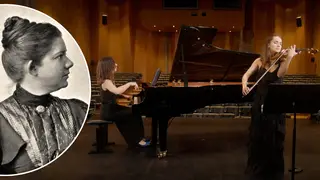
- During his final months, while receiving radium treatment and innumerable morphine injections, Debussy described himself as a "walking corpse". He confessed to Durand that, having lost his ability to compose, he could see "no reason for existing". Before his death, he completed one final masterwork, the Violin Sonata.
Did you know?
Debussy's obvious talent for the piano led to his winning a place at the junior department of the Paris Conservatoire when he was only 10 years old.