Take a look at our current subscription offers.
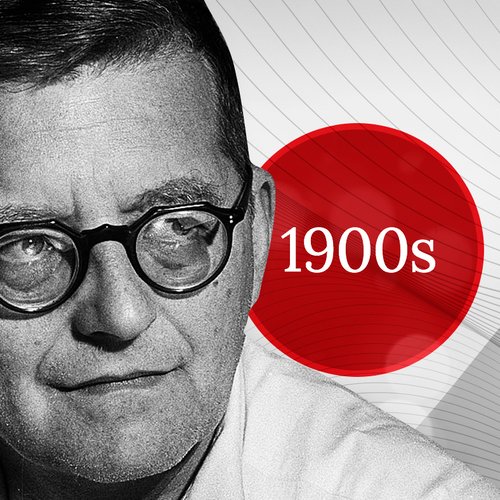
Dmitri Shostakovich
1906 – 1975
Shostakovich was the finest of all Russia's post-revolutionary composers - and the most enigmatic.
Life and Music
- Despite Shostakovich's exceptional talent, it was not until he was nine that he received his first formal piano lessons from his mother, a professional pianist.
- In 1919, composer Alexander Glazunov considered the young Shostakovich ready to begin his studies at the Petrograd Conservatory, where he was director.
- The 19-year-old Shostakovich produced a First Symphony that is an astonishing act of creative prodigy. Yet just as the young composer's musical imagination seemed set to take full flight, his talent became ensnared in the crippling web of Stalinist censorship. The notion of artistic freedom was soon no more than a cherished memory.
- Inevitably, Shostakovich's penchant for brittle irony soon began to land him in deep water with the authorities, initially for the "bourgeois decadence" of his satirical opera, The Nose (1927-8).
- In 1936, Stalin attended a performance of Shostakovich's operatic grotesquerie, Lady Macbeth of the Mtensk District. Dismayed by its lack of positivist flag-saving, the state newspaper, Pravda, slated this "bedlam of noise".
- With the gun of the Soviet regime pointed at his head - and Stalin's finger effectively on the trigger - Shostakovich knew he had to produce a surefire winner. The Fifth Symphony (1937), with its universal message of triumph achieved out of adversity, was exactly what the State wanted, and it made him a public hero.
- Shostakovich worked as a fire-fighter during the German siege of the city that year and Stalin's cronies lapped up the work, not suspecting the shallowness of the composer's apparently undying support.
- In 1946 Shostakovich's essentially light-hearted Ninth Symphony was officially censured for its "ideological weakness".
- In 1948, several composers, including Shostakovich and Prokofiev, were hauled over the coals by Pravda for "decadent formalism", an expression that effectively referred to music disapproved of by Stalin's sadistic henchman, Andrey Zhdanov. Recognising the need for self-preservation, Shostakovich reeled out a grovelling official apology whose insincerity must have been obvious to anyone except, apparently, the Soviet authorities.
- The deep-freeze of musical politicisation only began to thaw following Stalin's death in 1953, and the extremism of the 1948 edict in Pravda was officially recanted, with open encouragement of "independence, courage and experimentation".
- In 1953 Shostakovich also composed his masterly Tenth Symphony, written - although no one was aware of it at the time - as a reaction against the Stalinist regime, and in the case of the vitriolic Scherzo, a sardonic portrait of Stalin.
- The constant psychological torture had taken its toll, and it seems that in 1960, following the completion of his Eighth String Quartet, Shostakovich contemplated suicide. In 1966 he suffered a heart attack from which he never fully recovered, and which hastened a preoccupation with death which is tangibly realised in his angst-ridden Fourteenth Symphony.
- Shostakovich died a broken man.
Did you know?
One of Shostakovich's songs was sung by the cosmonaut Yuri Gagarin over the radio from his spacecraft to Mission Control down on earth.